Water quality plays a critical role in modern industries. Many manufacturing processes require water that is free from dissolved minerals, salts, and impurities to ensure product quality, equipment efficiency, and operational reliability.
This is where DM (Demineralized) Water Plants become essential. These plants produce high-purity water by removing dissolved ions such as calcium, magnesium, sodium, chlorides, sulfates, and silica.
From power plants and pharmaceutical industries to food processing and electronics manufacturing, DM water is widely used in applications where mineral-free water is essential.
What is a DM Water Plant?
DM Water Plant (Demineralized Water Plant) is a water treatment system designed to remove dissolved mineral salts and ions from raw water. Unlike conventional filtration systems that remove suspended particles, a DM plant eliminates ionic impurities through the ion exchange process, producing water with very low conductivity and high purity.
Demineralized water is commonly used in industries where even a small amount of mineral content can affect manufacturing quality or damage equipment.
Working Principle of a DM Water Plant
The working principle of a DM Water Plant is based on ion exchange technology. Specially designed resin beds exchange undesirable ions present in water with hydrogen (H⁺) and hydroxyl (OH⁻) ions.
The treatment process generally includes:
- Removal of suspended impurities through pre-filtration.
- Cation exchange resin removes positively charged ions like calcium, magnesium, sodium, and iron.
- Anion exchange resin removes negatively charged ions like chloride, sulfate, nitrate, and silica.
- Hydrogen and hydroxyl ions combine to form pure water (H₂O).
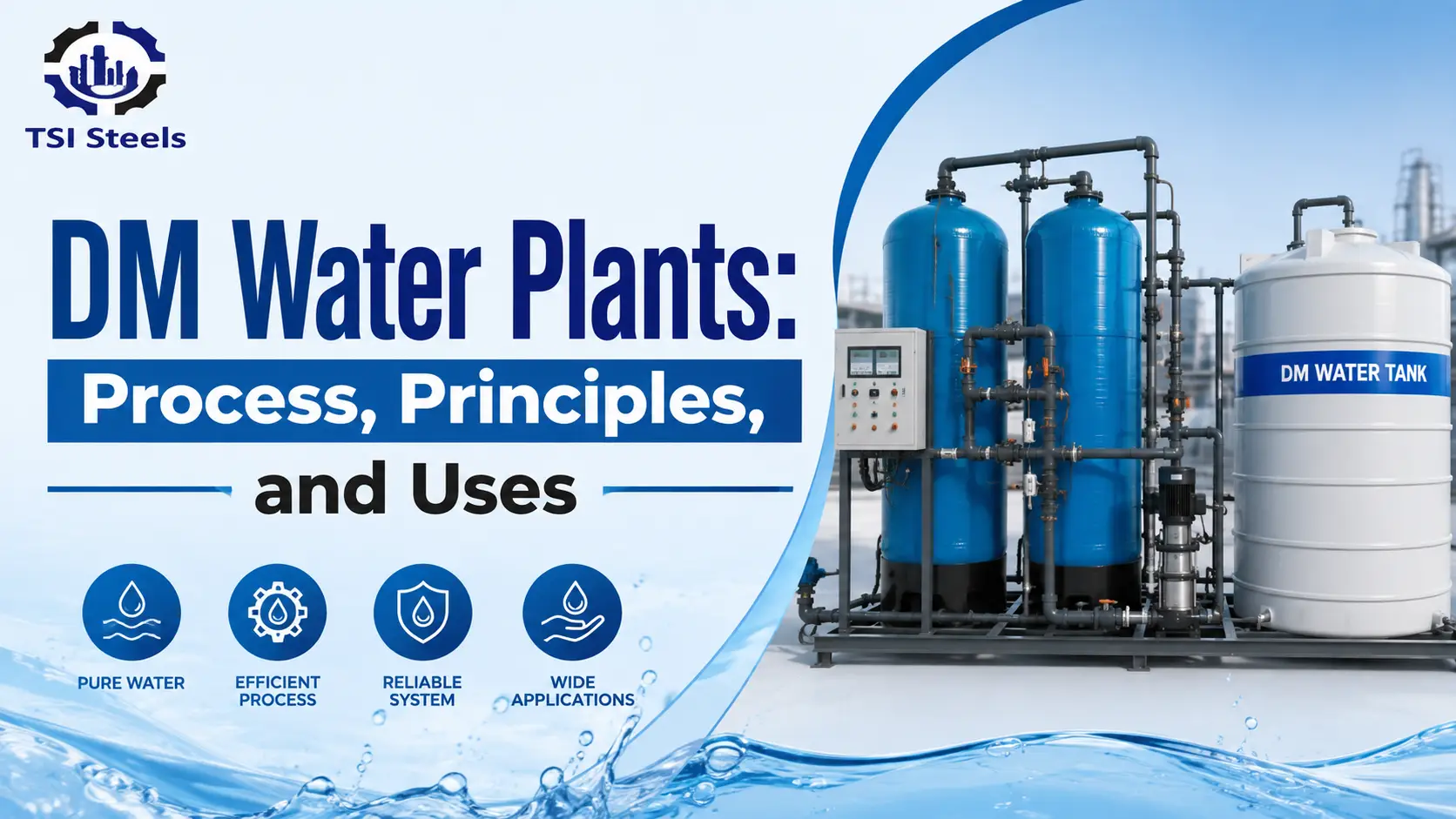
- The treated water is collected in a DM Water Storage Tank for industrial use.
This process produces high-quality demineralized water suitable for critical industrial applications.
DM Water Plant Process
1. Raw Water Collection
Raw water from borewells, municipal supply, or surface water sources is collected before treatment.
2. Pre-Treatment
The water passes through:
- Sand Filter
- Activated Carbon Filter
- Micron Cartridge Filter
These filters remove suspended solids, turbidity, chlorine, organic matter, and other contaminants that may reduce resin life.
3. Cation Exchange Unit
Water enters the cation exchanger where positively charged minerals such as:
- Calcium
- Magnesium
- Sodium
- Iron
are replaced by hydrogen ions.
4. Degassing (Optional)
Carbon dioxide generated during cation exchange may be removed using a degasser tower to improve water quality.
5. Anion Exchange Unit
The water then flows through the anion resin, which removes:
- Chlorides
- Sulfates
- Nitrates
- Silica
- Carbonates
These ions are replaced by hydroxyl ions.
6. Mixed Bed Polisher (Optional)
For ultra-pure water applications, a mixed bed resin unit provides final polishing and reduces conductivity to extremely low levels.
7. Storage
Finally, the purified water is stored in a DM Water Storage Tank, ensuring contamination-free storage before distribution to industrial processes.
Importance of a DM Water Storage Tank
Producing pure water is only one part of the process. Proper storage is equally important because exposure to contaminants can reduce water quality.
A high-quality DM Water Storage Tank offers several advantages:
- Maintains water purity after treatment
- Prevents contamination from external sources
- Minimizes corrosion and scaling
- Ensures uninterrupted industrial operations
- Suitable for long-term water storage
- Provides hygienic and leak-proof storage
- Supports continuous supply to production lines
TSI Steel manufactures robust and corrosion-resistant DM Water Storage Tanks that are designed to maintain water purity, withstand demanding industrial environments, and provide long service life. Our tanks are suitable for power plants, pharmaceutical industries, food processing units, chemical plants, textile industries, and many other industrial sectors.
Conclusion
DM Water Plants play a vital role in producing mineral-free water required by industries where water purity directly impacts product quality and equipment performance. Through advanced ion exchange technology, these systems remove dissolved salts and minerals, delivering highly purified water for a wide range of industrial applications.
Maintaining water quality after treatment is equally important. A durable and hygienic DM Water Tank ensures that demineralized water remains free from contamination until it is used. TSI Steel is a reliable DM Water Tank Manufacturer, providing reliable storage solutions that support efficient operations, preserve water purity, and deliver long-lasting performance.