Water storage tanks play a crucial role in residential, commercial, industrial, and municipal applications. Different types of water tanks are used for different purposes depending on factors such as storage capacity, installation requirements, environmental conditions, and material properties. Material is essential to ensure durability, hygiene, corrosion resistance, and long-term performance of tanks. Among the most widely used modern water storage solutions are GRP (Glass Reinforced Plastic) and FRP (Fiber Reinforced Plastic) water tanks, both known for their strength, lightweight construction, and excellent resistance to corrosion.
GRP and FRP Water Tanks
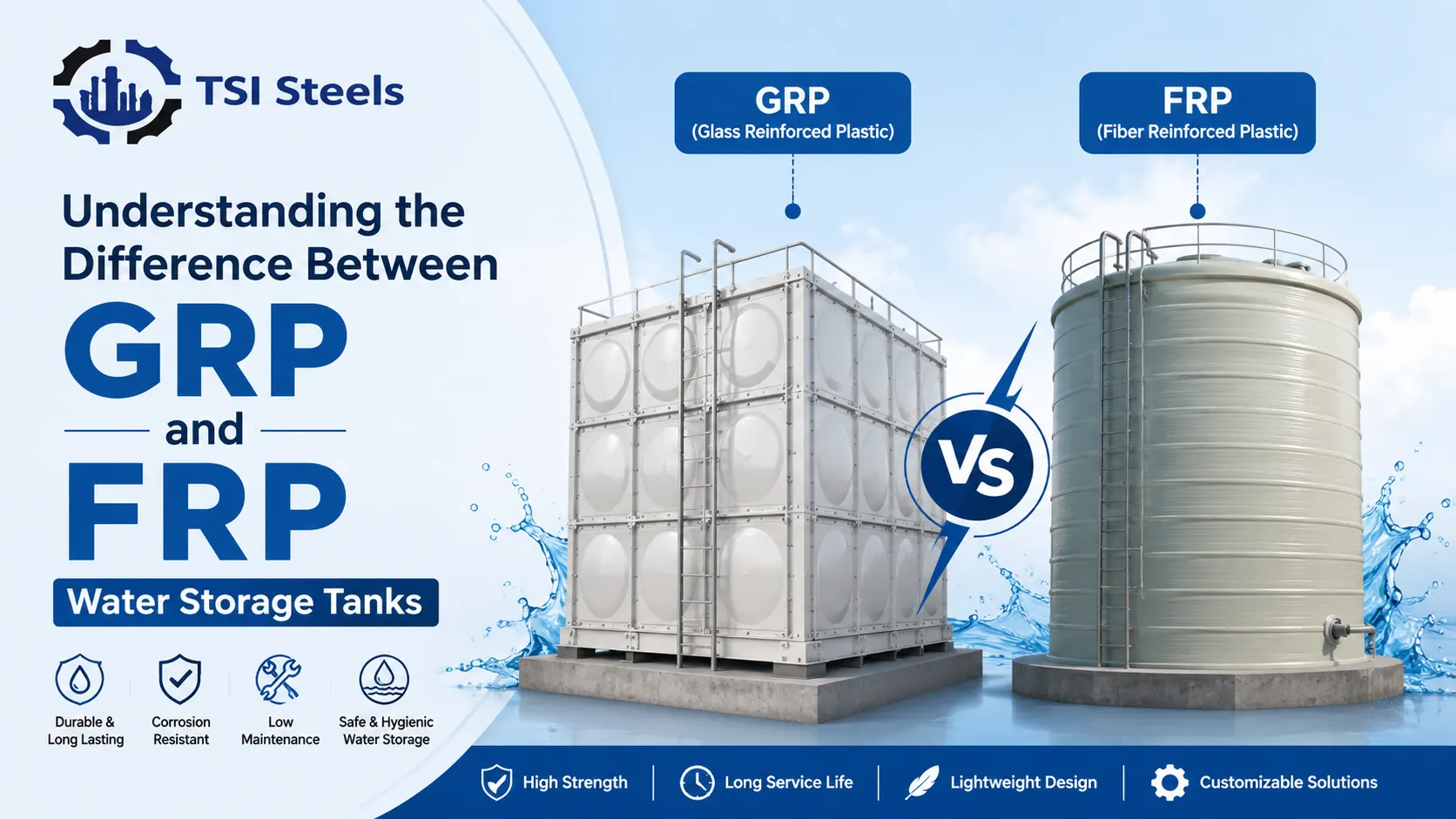
GRP Water Tanks: Full Form
GRP Water Tank full form is Glass Reinforced Plastic Tank, manufactured using high-quality plastic resin reinforced with glass fibers. These tanks are known for their excellent strength, corrosion resistance, lightweight construction, and long service life. GRP tanks are widely used in residential, commercial, industrial, and municipal water storage applications due to their durability and low maintenance requirements.
FRP Water Tanks: Full Form
FRP Water Tank full form is Fiber Reinforced Plastic Tank are made from plastic resin reinforced with various types of fibers, such as glass fibers, carbon fibers, or synthetic fibers. They offer high strength, chemical resistance, and excellent durability. FRP tanks are commonly used for water storage, chemical storage, and industrial applications where corrosion resistance and long-term performance are essential.
GRP vs FRP Water Tanks: Understanding the Difference
Although GRP and FRP tanks share many similarities, the primary distinction lies in the reinforcing material used during manufacturing.
1. Material Composition
GRP Tanks
- Reinforced specifically with glass fibers.
- Offer excellent structural strength.
- Highly resistant to environmental conditions.
FRP Tanks
- Reinforced with various types of fibers.
- May use glass fiber, carbon fiber, or other synthetic fibers.
- Performance varies depending on the reinforcement material.
2. Strength and Durability
GRP Water Storage tanks are known for their exceptional mechanical strength and structural stability. Glass fibers provide excellent resistance against impact, stress, and deformation.
FRP tanks also offer impressive durability, but their strength depends on the type and quality of fibers used in the manufacturing process.
3. Cost Considerations
GRP tanks are generally cost-effective because glass fibers are readily available and economical compared to specialty reinforcement fibers.
Certain FRP Water Storage tanks that utilize advanced reinforcement materials such as carbon fiber can be more expensive due to higher material costs.
4. Corrosion Resistance
Both GRP and FRP tanks offer excellent resistance to corrosion, rust, chemicals, and moisture. Unlike steel tanks, they do not require extensive anti-corrosion treatments or coatings.
This makes them ideal for water storage applications in harsh environmental conditions.
5. Weight
GRP and FRP tanks are significantly lighter than conventional steel or concrete tanks. Their lightweight construction simplifies transportation, installation, and maintenance while reducing structural load requirements.
6. Maintenance Requirements
Both tank types require minimal maintenance. Their non-corrosive surfaces help prevent rust formation and contamination, resulting in lower operational costs over time.
Advantages of GRP Water Tanks
- High strength with lightweight construction.
- Excellent corrosion and rust resistance.
- Long service life with minimal maintenance.
- Hygienic and safe for water storage.
- Easy installation and modular design.
Advantages of FRP Water Tanks
- Superior resistance to chemicals and corrosion.
- Durable and suitable for harsh environments.
- Lightweight and easy to transport.
- Low maintenance and operating costs.
- Available in various sizes and configurations.
Difference Between FRP VS GRP
| Feature | GRP (Glass Reinforced Plastic) Tank | FRP (Fiber Reinforced Plastic) Tank |
|---|---|---|
| Full Form | Glass Reinforced Plastic | Fiber Reinforced Plastic |
| Reinforcement Material | Glass fibers only | Glass, carbon, aramid, or other fibers |
| Strength | High structural strength | Strength varies based on fiber type |
| Durability | Excellent | Excellent |
| Corrosion Resistance | High | High |
| Weight | Lightweight | Lightweight |
| Maintenance | Low maintenance | Low maintenance |
| Cost | Generally more economical | Can be higher depending on fiber material |
| Water Storage Use | Widely used for potable and industrial water storage | Used for water, chemical, and industrial storage |
| Design | Commonly available in modular panel form | Available in various customized designs |
| Lifespan | Long service life | Long service life |
| Best Suited For | Large-capacity water storage applications | Water and specialized industrial applications |
Applications of GRP and FRP Tanks
Both GRP and FRP water tanks are widely used across numerous industries.
Residential Buildings
Used for domestic water storage, rainwater harvesting, and emergency water reserves.
Commercial Facilities
Hotels, hospitals, shopping complexes, educational institutions, and office buildings rely on these tanks for reliable water storage.
Industrial Plants
Manufacturing facilities use GRP and FRP tanks for process water, cooling water, and chemical storage applications.
Firefighting Systems
Large-capacity tanks provide emergency water reserves for fire protection systems.
Municipal Infrastructure
Cities and municipalities utilize these tanks for public water supply and wastewater management systems.
Agricultural Applications
Farmers use them for irrigation systems, livestock water storage, and rainwater collection.
Why Choose TSI Steel Industrial Water Tank Manufacturers?
TSI Steels Industrial Water Tank Manufacturers is known for delivering high-quality water storage systems designed to meet the diverse needs of residential, commercial, and industrial customers.
With a focus on quality materials, advanced manufacturing techniques, and customer satisfaction, we Industrial Water Tank Manufacturers provide durable and reliable water storage solutions engineered for long-term performance. Our commitment to quality ensures that every tank meets industry standards for safety, durability, and efficiency.
Conclusion
Understanding the difference between GRP and FRP water storage tanks helps buyers make informed decisions based on performance, durability, and budget requirements. While GRP is a specific type of FRP reinforced with glass fibers, both materials offer excellent corrosion resistance, lightweight construction, and long service life.
GRP tanks are often preferred for large-scale water storage applications due to their strength, modular design, and cost-effectiveness. FRP tanks provide flexibility and can be tailored for specialized industrial applications where specific reinforcement materials may be beneficial.